
To be classified broadly as a TPE, a material must satisfy two fundamental criteria: (1) rubber-like elasticity and (2) thermoplastic processability (melt-processable and recyclable). To better understand this diverse family, thermoplastic elastomers can be categorized into seven major groups based on their molecular structures and synthesis processes:
| Category | Representative Materials | Key Technical Features |
| Styrenic Block Copolymers (SBCs) | SBS, SEBS, SIS, SEPS | Block copolymers with polystyrene hard segments and butadiene/isoprene soft segments. Hydrogenation significantly improves weatherability and thermal stability. |
| Polyolefin-Based Elastomers | TPV, TPO, EPDM/PP, POE | Dynamic vulcanized rubber/plastic blends. TPV is fully vulcanized while TPO is a physical blend. Excellent weatherability and chemical resistance. |
| Thermoplastic Polyurethanes |
TPU (Polyester & Polyether types) |
Hard segments composed of serves with polyol soft segments. Outstanding abrasion and tear resistance, but limited performance under high temperatures. |
| Copolyester Elastomers | TPEE / COPE | PBT polyester hard segments with polyether/polyester soft segments. Heat resistance up to 200°C, highly suitable for demanding thermal environments. |
| Silicone-Based Elastomers | Silicone, SURLYN, TPSiV | Organosilicone backbone offering wide temperature range (-60°C to 230°C) and excellent biocompatibility, with moderate mechanical strength. |
| Polyamide Elastomers |
TPAE (e.g., PA12-TPAE, PEBA) |
Polyamide hard segments with polyether/polyester soft segments. Combines high metal-like mechanical strength with rubbery elasticity. |
Among all these categories, Styrenic Block Copolymers (SBCs / TPE-S) represent one of the most widely utilized and versatile families of thermoplastic elastomers.
1. What are SBC Elastomers?
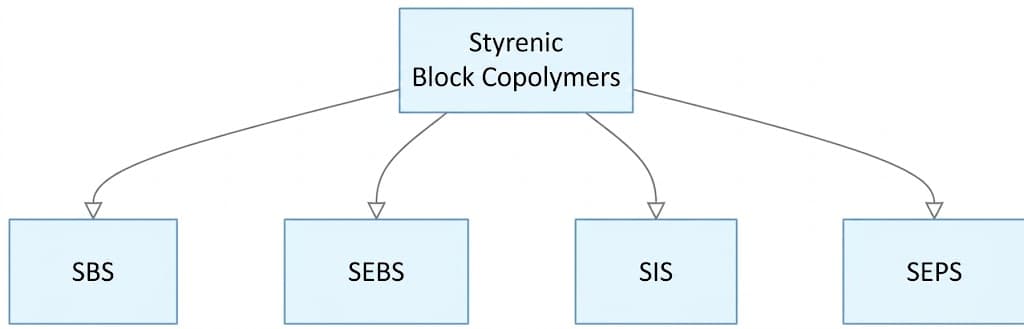
SBC materials combine the rubbery elasticity of conventional vulcanized rubber with the high processing efficiency of thermoplastics. They are triblock copolymers structured like a "sandwich": the outer hard polystyrene (PS) blocks provide mechanical strength and physical cross-linking, while the inner soft rubber blocks (butadiene, isoprene, or hydrogenated polyolefins) deliver flexibility and resilience.
To suit various performance requirements, SBC polymers can also be modified or compound-blended with PP, PE, TPU, or COPE to adjust hardness, toughness, and flowability.
2. Chemical Structure & Hydrogenation Comparison
| Grade | Hydrogenation Status | Rubber Mid-segment Features |
| Styrene-Butadiene-Styrene Block Copolymer (SBS) | Non-hydrogenated | Polybutadiene (Unsaturated double bonds) |
| Styrene-Ethylene-Butylene-Styrene Block Copolymer (SEBS) | Fully Hydrogenated | Ethylene-Butylene copolymer (Saturated structure) |
| Styrene-Isoprene-Styrene Block Copolymer (SIS) | Non-hydrogenated | Polyisoprene (Unsaturated double bonds) |
| Styrene-Ethylene-Propylene-Styrene Block Copolymer (SEPS) | Fully Hydrogenated | Ethylene-Propylene copolymer (Saturated structure) |
3. Core Performance Profiles: SBS vs. SEBS vs. SIS vs. SEPS
| Index | SBS | SEBS | SIS | SEPS |
| Hardness Range | Shore 30A – 90A | Shore 10A – 95A | Shore 20A – 80A | Shore 10A – 85A |
| Heat Resistance | Moderate (≤ 75°C) | Superior (Short-term >100°C) | Poor (≤ 60°C) | Good (≤ 110°C) |
| Weatherability & UV | Prone to yellowing | Excellent UV & ozone resistance | Prone to oxidation | High aging resistance |
| Natural Tackiness | Moderate | Low | Extremely High (Self-adhesive) | Low |
4. Advantages, Disadvantages & Key Applications
🔹 SBS
Pros: Economical pricing, excellent elasticity, high processing efficiency.
Cons: Poor UV aging resistance, softens above 75°C.
Key Applications: Footwear soles, low-cost toys, general asphalt modification, and basic plastic compounding.
🔹 SEBS
Pros: Outstanding weather/UV resistance, good oil resistance, non-deforming under long-term outdoor exposure.
Cons: Higher raw material cost, requires higher processing temperatures.
Key Applications: Automotive interior trims, outdoor tool handles, wire/cable jacketing, and soft-touch overmolding.
🔹 SIS
Pros: Superior natural tack, excellent low-temperature flexibility (remains soft down to -60°C).
Cons: Low heat resistance (softens at 60°C), relatively short service life.
Key Applications: Pressure-sensitive tapes, hot-melt adhesives, hygiene product backings, and sticky labels.
🔹 SEPS
Pros: Ultra-high elasticity, silk-soft tactile feel (baby-skin touch), high chemical resistance, and non-toxic safety.
Cons: Highest material cost, requires precise melt temperature control during processing.
Key Applications: Medical devices, luxury soft-touch grips, high-end consumer electronics, and gel cushions.
5. Practical Material Selection Guide
When selecting the ideal SBC grade for your manufacturing needs, consider these four rules:
Website: www.elephchem.com
whatsapp: (+)86 13851435272
E-mail: admin@elephchem.com



 Jaringan IPv6 didukung