
Dalam industri makanan yang sangat kompetitif saat ini, kemasan bukan lagi sekadar wadah—tetapi merupakan elemen penting dalam pengawetan produk. Dengan konsumen yang menuntut lebih sedikit pengawet buatan dan masa simpan yang lebih lama, merek makanan menghadapi tantangan teknis yang besar: mencegah masuknya oksigen tanpa menambah berat atau volume yang tidak perlu.
Memasuki EVOH (Kopolimer Etilen-Vinil Alkohol)Termoplastik berkinerja tinggi ini dengan cepat menjadi standar emas untuk kemasan makanan penghalang tinggi, melindungi produk sensitif dari pembusukan, hilangnya rasa, dan degradasi di seluruh rantai pasokan global.
1. Apa Sebenarnya EVOH Itu?
Pada dasarnya, EVOH adalah kopolimer acak etilena dan vinil alkohol. Untuk memahami mengapa ia bekerja dengan sangat baik, kita harus melihat lebih dekat arsitektur molekulnya:
2. Menguraikan Tingkat EVOH: Faktor Mol%
Tidak semua EVOH diciptakan sama. Kinerja material ini sangat ditentukan oleh Kandungan Etilennya (dinyatakan dalam Mol% atau persen mol). Saat memilih model EVOH untuk lini pengemasan Anda, memilih grade yang tepat sangat penting untuk menyeimbangkan kinerja penghalang dengan persyaratan pemrosesan.
| Kandungan Etilen EVOH | Karakteristik & Kinerja Utama | Aplikasi Terbaik | ||
| Etilen Rendah (27 – 29 mol%) | Efisiensi penghalang gas yang ekstrem karena kristalinitas monoklinik yang tinggi. Sangat sensitif terhadap kelembapan. | Produk dengan masa simpan sangat panjang, barang kering, dan kemasan bahan kimia industri khusus. | ||
| Kelas Standar (32-35 mol%) (Kuraray EVAL F101B) | "Titik ideal" industri. Memberikan keseimbangan yang sangat baik antara sifat penghalang gas, stabilitas termal, dan kemudahan ekstrusi. | Daging dingin, produk susu, makanan olahan, dan botol peras berlapis ganda. | ||
| Etilen Tinggi (38 – 48 mol%) (EVALUASI H171B) | Daya regang yang sangat baik, titik leleh yang lebih rendah, dan ketahanan yang unggul terhadap kelembapan, meskipun penghalang gas sedikit menurun. | Thermoforming deep-draw, skin packaging, dan film fleksibel dengan daya regang tinggi. | ||
3. Pusat Kekuatan Multilayer: Mengintegrasikan Polimer Lain
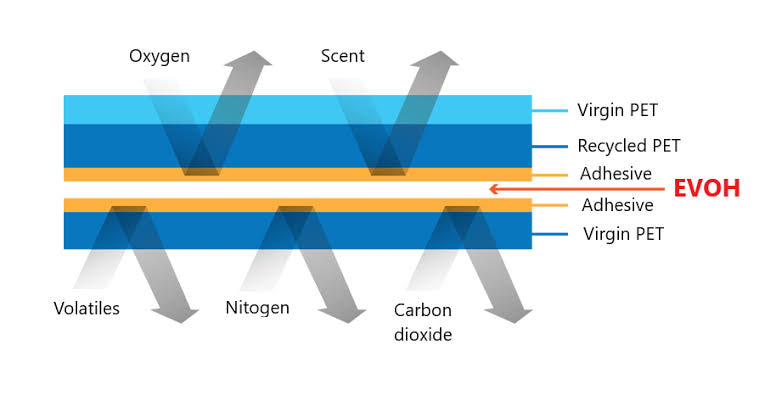
Karena EVOH pada dasarnya bersifat hidrofilik (menyerap air, yang dapat melemahkan penghalang gasnya untuk sementara), EVOH jarang digunakan sebagai film tunggal. Sebaliknya, EVOH direkayasa menjadi struktur ko-ekstrusi multi-lapisan berteknologi tinggi—seringkali berjumlah 5, 7, atau 9 lapisan—di mana lapisan mikroskopis EVOH (seringkali di bawah 10 mikron) dilindungi oleh polimer berkinerja tinggi lainnya.
Susunan ekstrusi bersama berpenghalang tinggi yang umum meliputi:
Alternatif Ramah Lingkungan untuk PVDC: Secara historis, PVDC (Polivinilidena Klorida) merupakan material penghalang yang dominan. Namun, karena PVDC mengandung klorin, ia melepaskan dioksin berbahaya selama pembakaran dan mempersulit daur ulang. EVOH hanya mengandung karbon, hidrogen, dan oksigen, menjadikannya alternatif yang jauh lebih aman dan bebas klorin untuk merek-merek berkelanjutan modern.
4. PP vs. EVOH: Memahami Sinergi
Pertanyaan umum dalam pengadaan kemasan adalah apakah akan menggunakan PP atau EVOH. Kenyataannya, keduanya adalah mitra, bukan pesaing.
| Fitur | Polipropilena (PP) | Kopolimer EVOH |
| Peran Utama | Integritas struktural, penghalang kelembaban, penyegelan panas. | Penghalang gas (Oksigen, Aroma, VOC). |
| Penghalang Oksigen | Relatif rendah. | Sangat tinggi (mencegah masuknya $O_2$). |
| Penghalang Kelembaban | Tinggi (melindungi terhadap uap air). | Sensitif terhadap kelembapan jika tidak terlindungi. |
| Ketahanan Kimia | Sangat efektif melawan asam, lemak, dan minyak. | Ketahanan tinggi terhadap pelarut organik dan minyak mineral. |
| Profil Biaya | Polimer komoditas ekonomis. | Resin khusus premium (digunakan secukupnya). |
Dengan menggabungkannya—menggunakan PP untuk lapisan pelindung luar yang kuat dan sedikit EVOH untuk perisai oksigen bagian dalam—para produsen mencapai struktur berkinerja tinggi dan hemat biaya.
5. Manfaat Ekonomi & Lingkungan
Penerapan teknologi multi-lapisan EVOH menghasilkan keuntungan yang signifikan baik dari segi laba maupun lingkungan:
"Lebih Sedikit Material, Lebih Banyak Fungsi": Karena EVOH memberikan penghalang yang luar biasa dengan ketebalan hanya beberapa mikron, hal ini memungkinkan pengurangan ketebalan secara drastis (pengurangan bobot). Ini mengurangi konsumsi bahan baku dan menurunkan biaya pengiriman.
Anti-Statik & Tampilan Bersih: EVOH memiliki sifat anti-statis alami. Saat diintegrasikan di dekat lapisan permukaan, EVOH mencegah penumpukan debu di rak-rak toko, memastikan tampilan kemasan yang mengkilap, jernih, dan sangat transparan yang menarik pembeli.
Pengurangan Limbah Makanan Secara Besar-besaran: Dengan menghilangkan penetrasi oksigen, EVOH secara dramatis menunda oksidasi, hilangnya warna, dan pembusukan tanpa memerlukan penambahan pengawet buatan dalam jumlah besar.
Memilih jenis EVOH dan struktur multi-lapisan yang ideal sepenuhnya bergantung pada siklus hidup spesifik produk Anda—apakah memerlukan pembentukan termal tarik dalam, sterilisasi suhu tinggi, atau penyimpanan suhu ruang yang lama. Dengan mengintegrasikan kopolimer EVOH yang tepat sasaran dengan poliolefin standar, sistem pengemasan modern mencapai keseimbangan ideal antara daya tahan, efisiensi biaya, dan pengawetan kesegaran kelas dunia.
Situs web: www.elephchem.com
WhatsApp: (+)86 13851435272
Email: admin@elephchem.com



 Jaringan IPv6 didukung