Dalam beberapa tahun terakhir, percakapan global seputar polusi plastik semakin intensif, dengan mikroplastik muncul sebagai masalah lingkungan utama. Seiring industri beralih ke material berkelanjutan, Polivinil Alkohol (PVA) PVA telah mendapatkan daya tarik yang signifikan karena sifatnya yang unik, yaitu larut dalam air. Namun, pertanyaan kritis sering muncul di forum regulasi dan komersial yang sadar lingkungan: Apakah PVA termasuk mikroplastik?
1. Apa itu Mikroplastik?
Untuk menjawab pertanyaan mengenai PVA, kita harus menggunakan definisi yang tepat yang ditetapkan oleh Badan Kimia Eropa (ECHA) dan standar lingkungan global:
Mikroplastik adalah polimer hidrokarbon sintetis padat yang tidak larut dalam air, sangat persisten, dan mengalami fragmentasi mekanis daripada degradasi kimia, sehingga menyebabkan bioakumulasi di ekosistem laut dan darat.
2. Perbedaan Utama: Kelarutan dan Biodegradabilitas
PVA sangat berbeda dengan poliolefin tradisional yang persisten seperti polietilen (PE) atau polipropilen (PP). Berikut cara PVA membedakan dirinya melalui perilaku molekuler:
Pembubaran Molekuler vs. Fragmentasi Fisik
Jalur Biodegradasi Sejati
Setelah larut, kerangka karbon PVA menjadi mudah diakses oleh konsorsium mikroba tertentu (seperti spesies Pseudomonas, Sphingomonas, dan Alcaligenes) yang umumnya terdapat di instalasi pengolahan air limbah (WWTP) dan ekosistem perairan alami.
Biodegradasi mengikuti jalur enzimatik yang ketat:
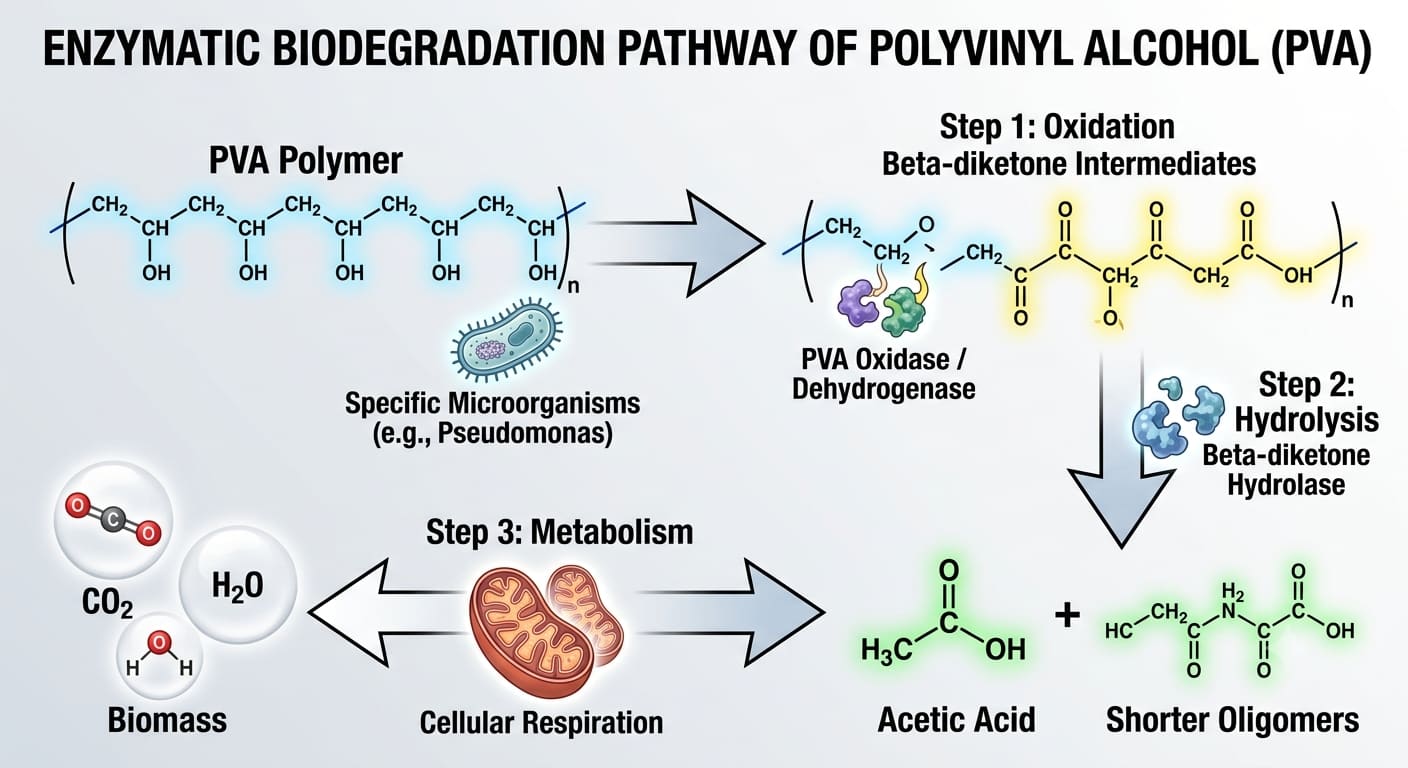
Tidak seperti mikroplastik yang menumpuk tanpa batas waktu, PVA yang terlarut pada akhirnya akan mengalami mineralisasi menjadi karbon dioksida, air, dan biomassa yang tidak beracun.
| Fitur | Plastik Konvensional (misalnya, PE, PP, PET) | Polivinil Alkohol (PVA) |
| Keadaan Fisik dalam Air | Partikel padat yang tidak larut | Larut sepenuhnya dalam air |
| Mekanisme Kerusakan | Fragmentasi fisik (Menciptakan Mikroplastik) | Pelarutan molekuler & mineralisasi biologis |
| Ketahanan Lingkungan | Berabad-abad | Beberapa minggu hingga beberapa bulan (tergantung pada aktivitas mikroba) |
| Risiko Bioakumulasi | Tinggi (masuk ke dalam rantai makanan) | Tidak ada (tidak beracun, tidak bersifat akumulatif) |
4. Adaptasi Teknis & Implementasi Industri
Efektivitas lingkungan PVA sangat bergantung pada arsitektur molekulnya. Sebagai produsen profesional, kami mengontrol dua variabel penting selama fase polimerisasi dan hidrolisis:
Untuk audit kepatuhan perusahaan, rangkaian produk kami menjalani pengujian standardisasi yang ketat, selaras dengan OECD 301B (Ready Biodegradability) dan sertifikasi kelarutan dalam air internasional.
Situs web: www.elephchem.com
WhatsApp: (+)86 13851435272
E-mail: admin@elephchem.com


 Jaringan IPv6 didukung